
Make playtime safer, more purposeful and more enjoyable with this Before You Play safety and learning checklist for ages 3–6.
This free 2-page printable helps adults prepare the play space and check the toy before use, while giving young children simple, positive ways to ask for help, take turns, imagine, play together and tidy up.
The safety checks are intentionally adult-led. Children are encouraged to communicate when something does not seem right rather than being asked to inspect or certify a toy themselves.
Age: 3–6 · Subject: Early Learning / Life Skills · Skills: Safety awareness, communication, turn-taking, imaginative play, tidy-up routines Format: Printable PDF · Pages: 2
You will receive an email with PDF Link.
ABOUT THIS WORKSHEET
Before You Play is a simple safety and learning checklist designed for preschool children and the adults who supervise their play.
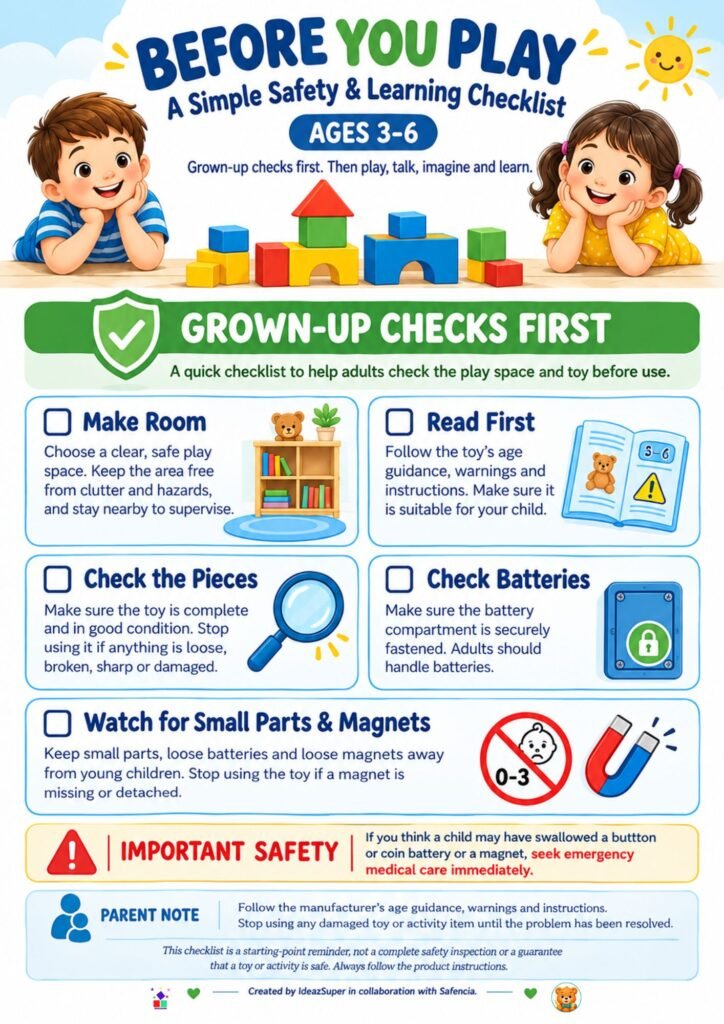
Page 1 — Grown-Up Checks First
The first page focuses on the adult’s role before play begins:
- Make Room — prepare a clear, safe play space.
- Read First — follow the toy’s age guidance, warnings and instructions.
- Check the Pieces — make sure the toy is complete and free from loose, broken or sharp parts.
- Check Batteries — make sure battery compartments are securely fastened and that adults handle batteries.
- Watch for Small Parts & Magnets — keep small parts, loose batteries and loose magnets away from young children and stop using a toy if a magnet becomes missing or detached.
These checks reflect general toy-safety guidance from Health Canada and the U.S. Consumer Product Safety Commission.
Page 2 — Play, Talk & Take Turns
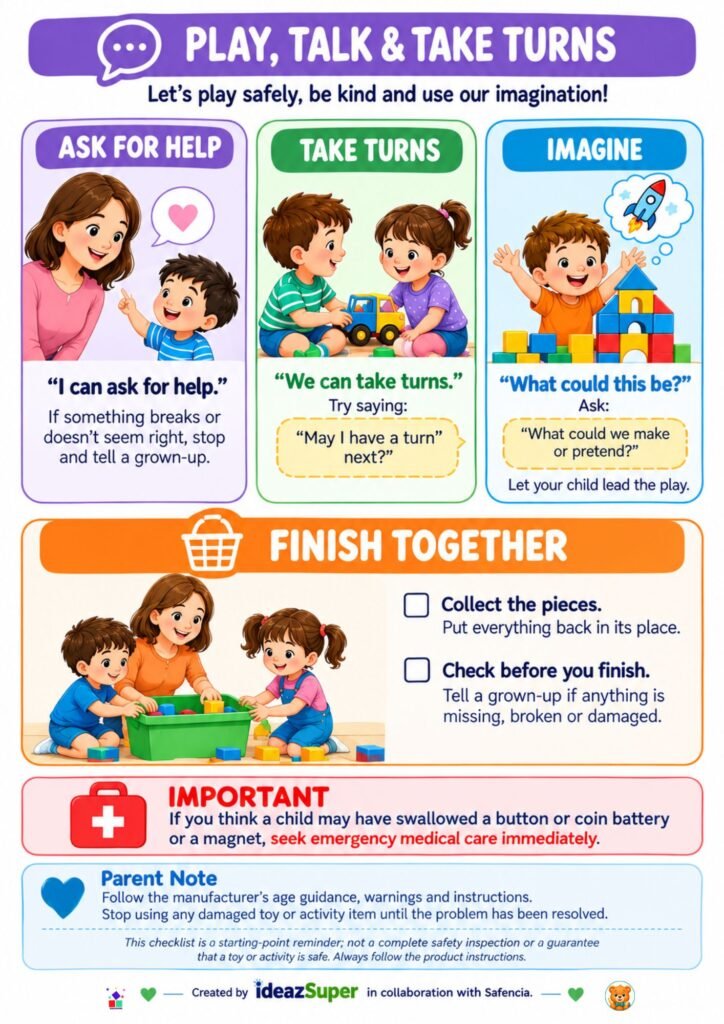
The second page moves from safety preparation into positive play:
Ask for Help
“I can ask for help.”
Children are encouraged to stop and tell a grown-up if something breaks or doesn’t seem right.
Take Turns
“We can take turns.”
The child is given a simple phrase to use: “May I have a turn next?”
Imagine
“What could this be?”
Adults can ask, “What could we make or pretend?” and allow the child to lead the play.
Finish Together
Children can help collect the pieces and put everything back in place, while telling a grown-up if anything is missing, broken or damaged.
The play section draws on paediatric guidance around supporting children’s social play, cooperation, turn-taking, positive language, creativity and imagination. The specific prompts used in this worksheet are original editorial suggestions, not a validated learning assessment.
IMPORTANT SAFETY NOTE
The resource includes a separate safety reminder for suspected button/coin battery or magnet ingestion. If you think a child may have swallowed a button or coin battery or a magnet, seek emergency medical care immediately.
Safety awareness · Recognising when to ask an adult for help · Communication during play · Turn-taking language · Cooperative play · Imaginative thinking · Child-led play · Tidying and responsibility
HOW TO USE
Before Play
An adult can quickly work through the Grown-Up Checks First section before the child begins playing.
During Play
Use the Ask for Help, Take Turns and Imagine prompts naturally during play rather than turning them into a test.
After Play
Invite the child to help collect the pieces and tidy the play area.
If Something Is Wrong
Stop using a toy if it is broken, damaged, has a loose hazardous part or has a missing/detached magnet, and follow the manufacturer’s instructions or seek appropriate advice.
WHERE THIS RESOURCE FITS
- Before this resource:
Toy-Buying & Safety Checklist — helps adults think through buying, receiving and inspecting a toy.
- This resource:
Before You Play — prepares the play space, checks the toy before use, supports positive play and finishes with tidy-up.
- Next step:
Use the checklist as a simple repeatable pre-play routine rather than a one-time activity.
Looking for guidance before purchasing a toy?
Try the Toy-Buying & Safety Checklist for a broader sequence covering:
Before You Buy → When It Arrives → Inspect → Before First Use → Supervise
Then use Before You Play as the simple everyday play-time reminder.
RELATED RESOURCES
- Toy-Buying & Safety Checklist
- Before You Play — Safety & Learning Checklist
- IdeazSuper Life Skills Worksheets
- IdeazSuper Preschool Worksheets
- IdeazSuper Learning Through Play Resources
- All IdeazSuper Worksheets
FAQ
What age is this checklist for?
This checklist is designed for children ages 3–6, with the safety checks intended to be completed by an adult.
Is this a toy safety inspection?
No. It is a starting-point reminder, not a complete safety inspection or a guarantee that a toy or activity is safe. Adults should always follow the manufacturer’s age guidance, warnings and instructions.
Should children check the toy themselves?
No. The safety checks are adult-led. Children are encouraged to ask a grown-up for help when something breaks or does not seem right.
What does the checklist cover?
It covers preparing the play space, reading toy instructions and age guidance, checking toy condition and batteries, watching for small parts and magnets, asking for help, taking turns, imaginative play and tidying up.
Why does it mention batteries and magnets?
Button/coin batteries and small magnets can cause serious injuries if swallowed. Official safety guidance recommends keeping them away from children and seeking immediate medical attention if ingestion is suspected.
Is this checklist based on Pakistani toy-safety law?
No. The safety wording is informed by Canadian and U.S. public-safety and paediatric references and is provided as general safety information. It should not be interpreted as a statement of Pakistani law or as evidence that any particular Safencia product is certified.
EVIDENCE BEHIND THE WORDING
I’ll include the supplied evidence section at the bottom of the webpage, keeping the printable itself clean and child-friendly while giving parents and educators access to the references behind the resource.
The sources will include:
- Health Canada — Toy Safety Tips
- U.S. Consumer Product Safety Commission — Button Cell and Coin Batteries
- U.S. Consumer Product Safety Commission — Child Safety: The Hidden Dangers of Magnets
- U.S. Consumer Product Safety Commission — Magnet Safety Alert
- American Academy of Pediatrics / HealthyChildren.org — Young Children Learn a Lot When They Play
Created by IdeazSuper in collaboration with Safencia